เข้าชม 295 ครั้ง
ปรับปรุงครั้งที่ / (วันที่ 30 ต.ค. 66 )
นำมาใช้งาน พ.ศ. 2566
ครอบคลุมใช้ในกระบวนการที่เกี่ยวข้องทั้งหมด
ผู้พัฒนา : Maj.Monai Meesaeng, MD
เบอร์โทร : 0902709449
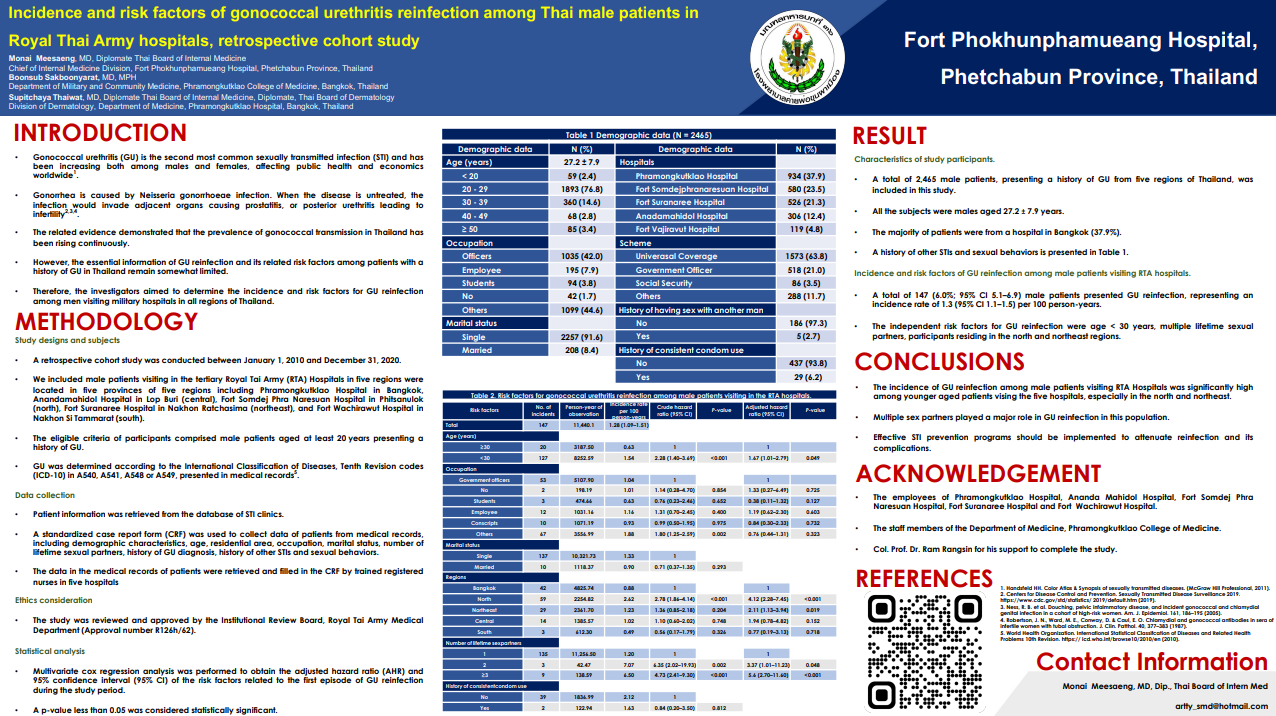
Incidence and risk factors of gonococcal urethritis reinfection among Thai male patients in Royal Thai Army hospitals, Retrospective cohort study
The prevalence of gonococcal urethritis is the second most common of sexual transmission disease and has been increasing both male and female, it affected to public health and economics worldwide. Understanding the current epidemiology of gonococcal urethritis in Thailand will facilitate more effective national sexual transmission disease (STD) programs. This study aimed to determine the incidence and risk factors for recurrent gonococcal urethritis among Thai men.
คุณสมบัติ
ABSTRACT
Incidence and risk factors of gonococcal urethritis reinfection among Thai male patients in
Royal Thai Army hospitals, Retrospective cohort study
Monai Meesaeng1
, Boonsub Sakboonyarat2
, , *Supitchaya Thaiwat1
1 Department of Medicine, Fort Phokhunphamueang Hospital, Phetchabun Province, Thailand 76000
2 Department of Military and Community Medicine, Phramongkutklao College of Medicine, Bangkok, Thailand 10400
3 Department of Medicine, Phramongkutklao Hospital and College of Medicine, Bangkok, Thailand 10400
*Corresponding author: Supitchaya Thaiwat
Department of Medicine, Phramongkutklao Hospital and College of Medicine, Bangkok, Thailand 10400
Background: Understanding the current epidemiology of gonococcal urethritis in Thailand will facilitate more effective
national sexual transmission disease(STD) programs. This study aimed to determine the incidence and risk factors for
recurrent gonococcal urethritis among Thai men
Methods: A retrospective cohort study was conducted in male patients visiting in the Royal Thai Army hospitals
located in 5 provinces: Phisanulok (North), Lopburi (Central), Nakhon Si Thammarat (South), Nakhon Ratchasima
(Northeast) and Bangkok. The male patients who were diagnosed gonococcal urethritis in Januray 2010 and October
2020 were included in the study. The incidence rate of recurrent gonococcal urethritis and the incidence rate ratio
(IRR) based on a Poisson regression model were used to identify the independent factors associated with recurrent
gonococcal urethritis.
Results: A total of 2,465 male patients with a history of gonococcal urethritis was included in the present study. The
incidence rate of recurrent gonococcal urethritis among participants was 1.28/100 person-year. The Poisson regression
model were used to identify the independent factors associated with recurrent gonococcal urethritis in Thai men
included aged < 25 years was 2.05/100 person-years(adjusted IRR = 2.02, 95% CI, 1.40-2.92), the North region was
2.62/100 person-year(adjusted IRR = 2.02, 95% CI, 1.96-4.51) and multiple sex partners more than two was 6.5/100
person-years(adjusted IRR = 5.98, 95% CI, 2.98-12.01).
Conclusion: In conclusion, the recurrent gonococcal urethritis was still the essential health issue in Thailand. High risk
sexual activity, including having a history of multiple sexual partners, played a major role in recurrent gonococcal
urethritis among this population. Effective of recurrent gonococcal urethritis prevention programs should cover young
Thai men, especially residing in the north of Thailand.
Key words: Gonorrhea infection, Neisseria gonorrhea, Sexually Transmitted Disease (STD), condoms, Army Hospital
ไฟล์ดาวน์โหลด ดาวน์โหลดไฟล์ทั้งหมด
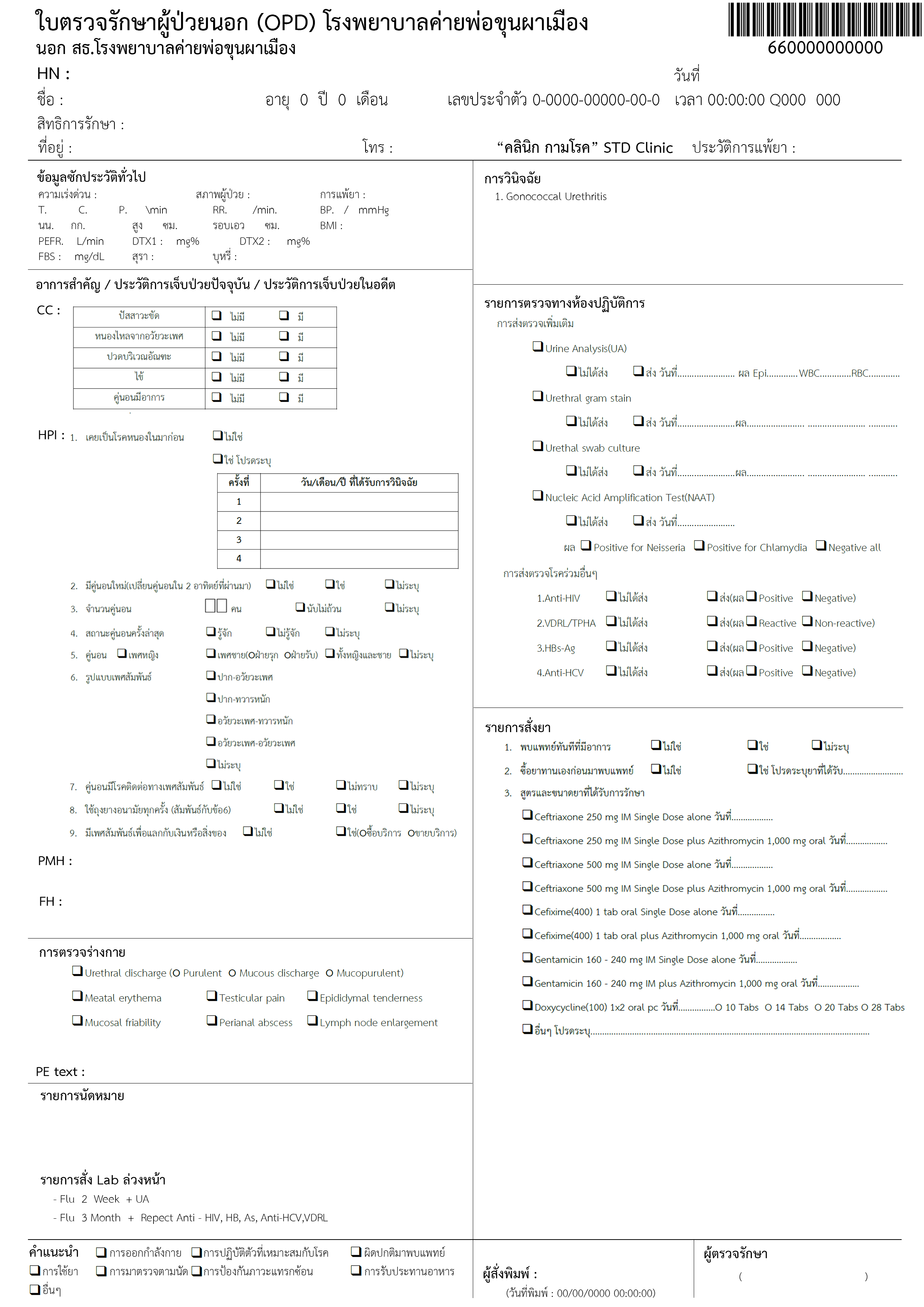
Case report form Retrospective Study
ขนาดไฟล์ : 346 KB ดาวน์โหลด : 0อัลบั้มภาพ ดาวน์โหลดภาพทั้งหมด